Idols
Growing up in the suburbs of Wisconsin, I had little interest in the culture of my ancestors. I sought only to blend in — without yet realizing I never could. It was only much later, through my art practice, that I began to discover how culture, memory, and history persist — sometimes even without our knowing. These works are an attempt to examine the stories and myths of my ancestors through the lens of a dual-culture upbringing, to memorialize them, and to find the connections that were always there, waiting to be uncovered.
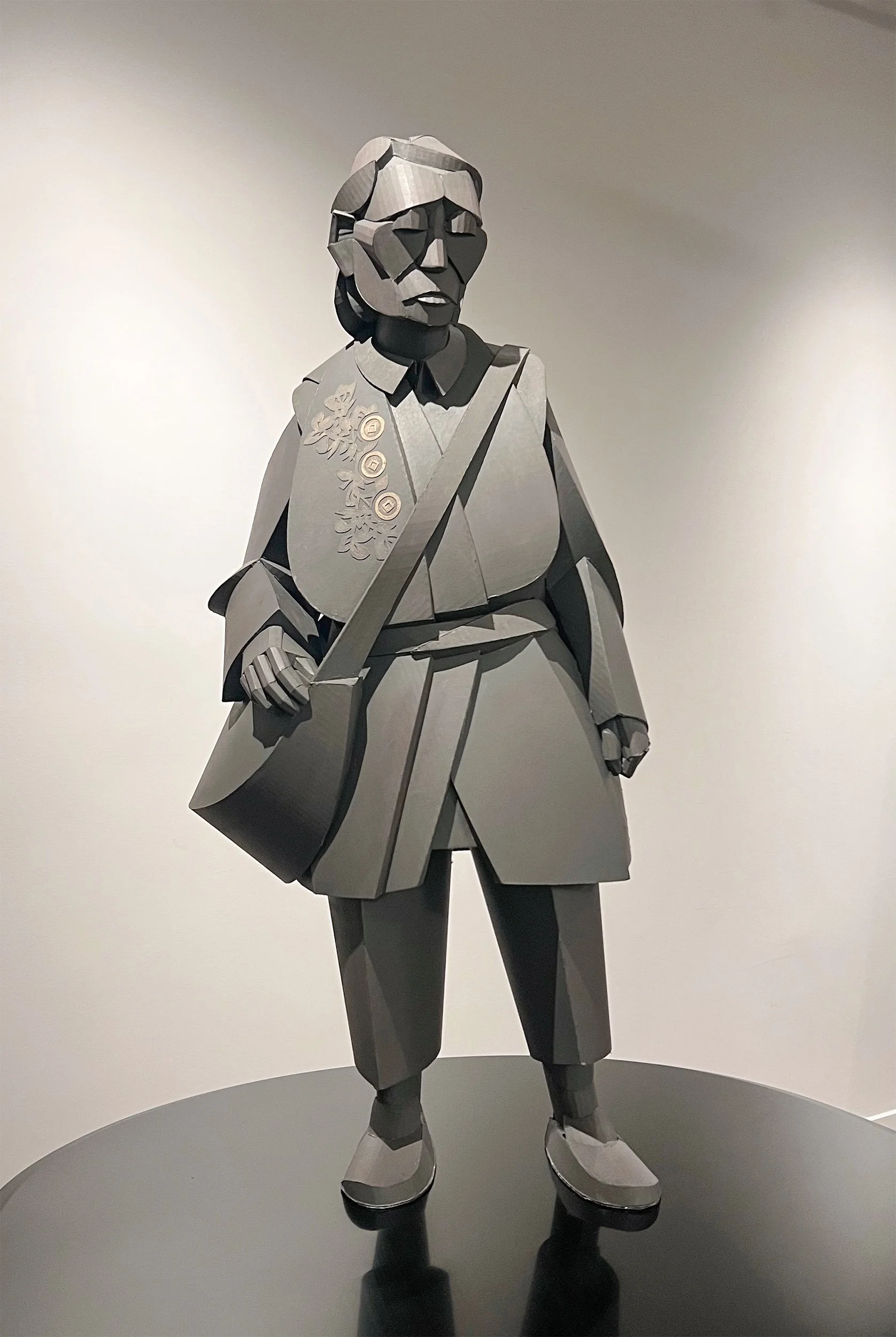
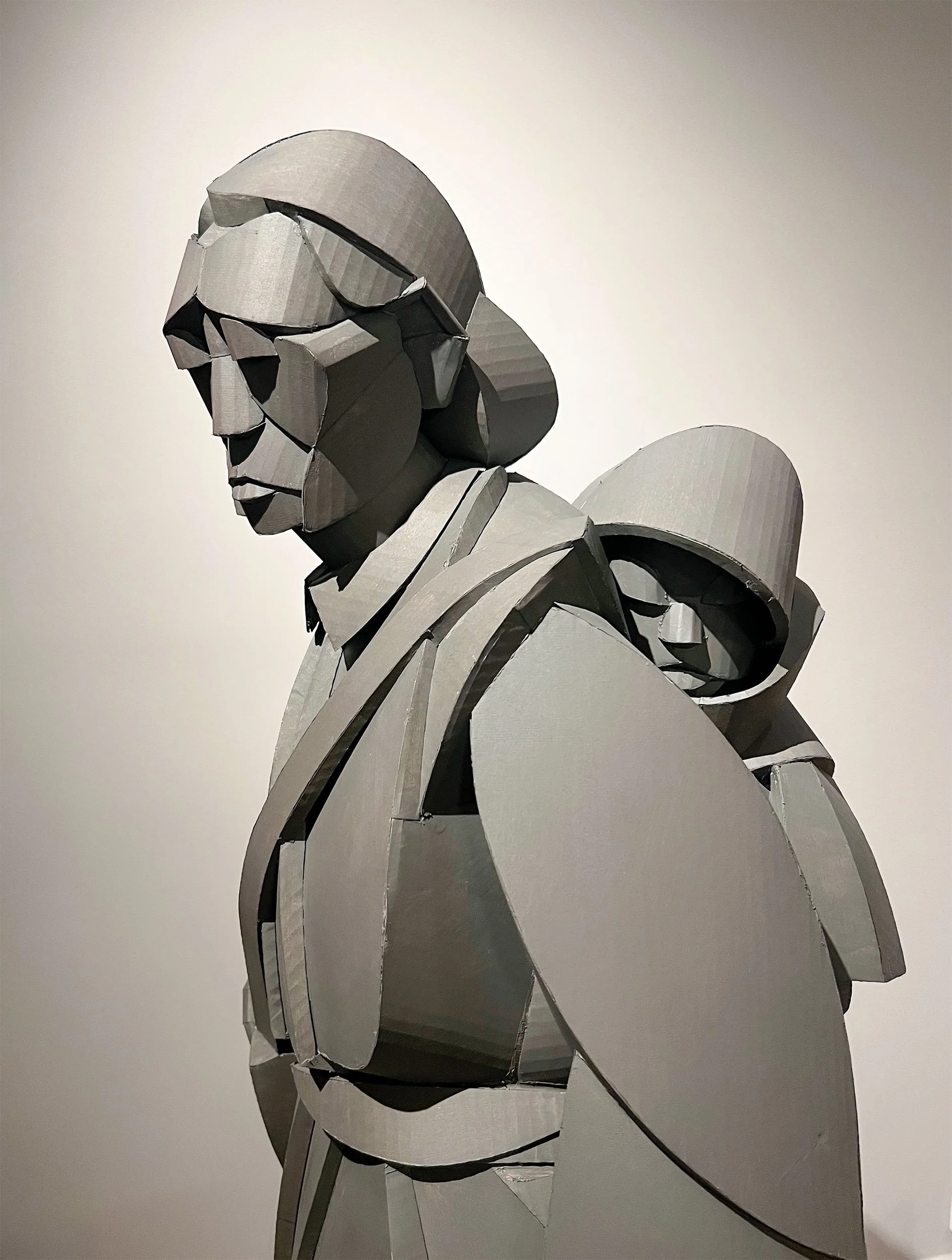
The Road Leads Home, 2024
Corrugated cardboard, acrylic ink
41 x 19 x 15 in.
My family's comfortable life in Wisconsin began with my grandmother's first steps out of her home in China, toward an uncertain future. The young air force pilot she had recently married had been relocated to another city — the separation was unbearable, so she made the decision herself. She packed what she could, sewed a few gold coins into the lining of her clothes to guard against bandits on the road, strapped her infant son to her back, and walked out into a country torn apart by war. She never saw her family again. What followed were years of bomb shelters, food shortages, and forced migration — but also, eventually, survival. When I think about how we ended up in the quiet suburbs of Wisconsin, I trace it back to those first steps — to what she carried, and what she left behind.
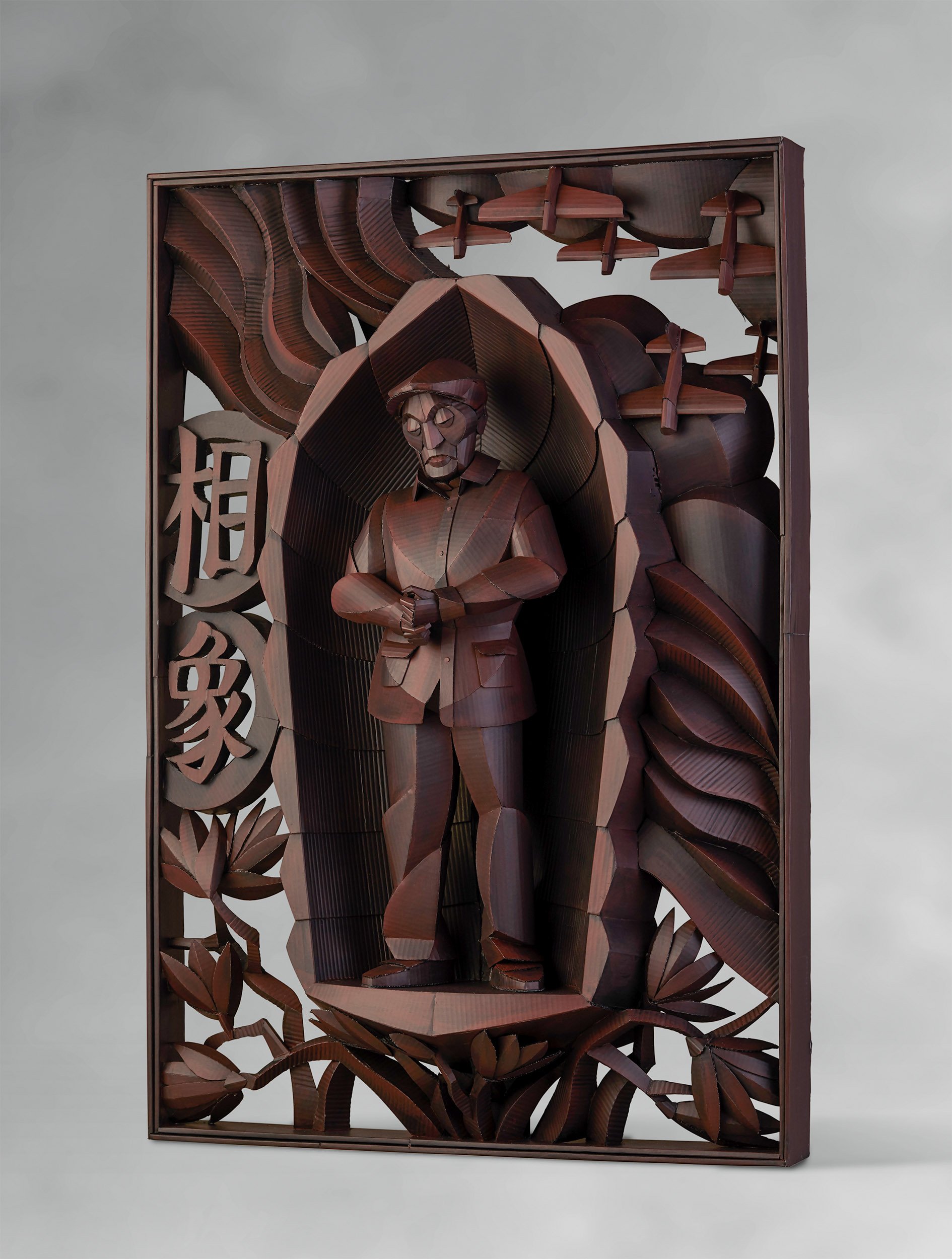
Blocking the Elephant’s Eye, 2018
Corrugated cardboard, acrylic ink
50 x 34 x 4 in.
This piece is about one moment where a family's fate split in two. When the Communist Revolution came, most of my father's family fled to Taiwan — they rebuilt from scratch, found success, and eventually settled across the world, including Wisconsin, where they raised their children in safety and comfort. One family member stayed. My father's idealistic uncle believed in the revolution, and so he remained to help. While his siblings built new lives abroad, he lived through the war, then the horrors of the Cultural Revolution — and eventually met with a tragic end. That divergence — one man going one way while his family went another, each following their own convictions — set off consequences that would echo through generations. I keep returning to that moment, trying to understand how much of a life, how much of a destiny, can hinge on a single decision.
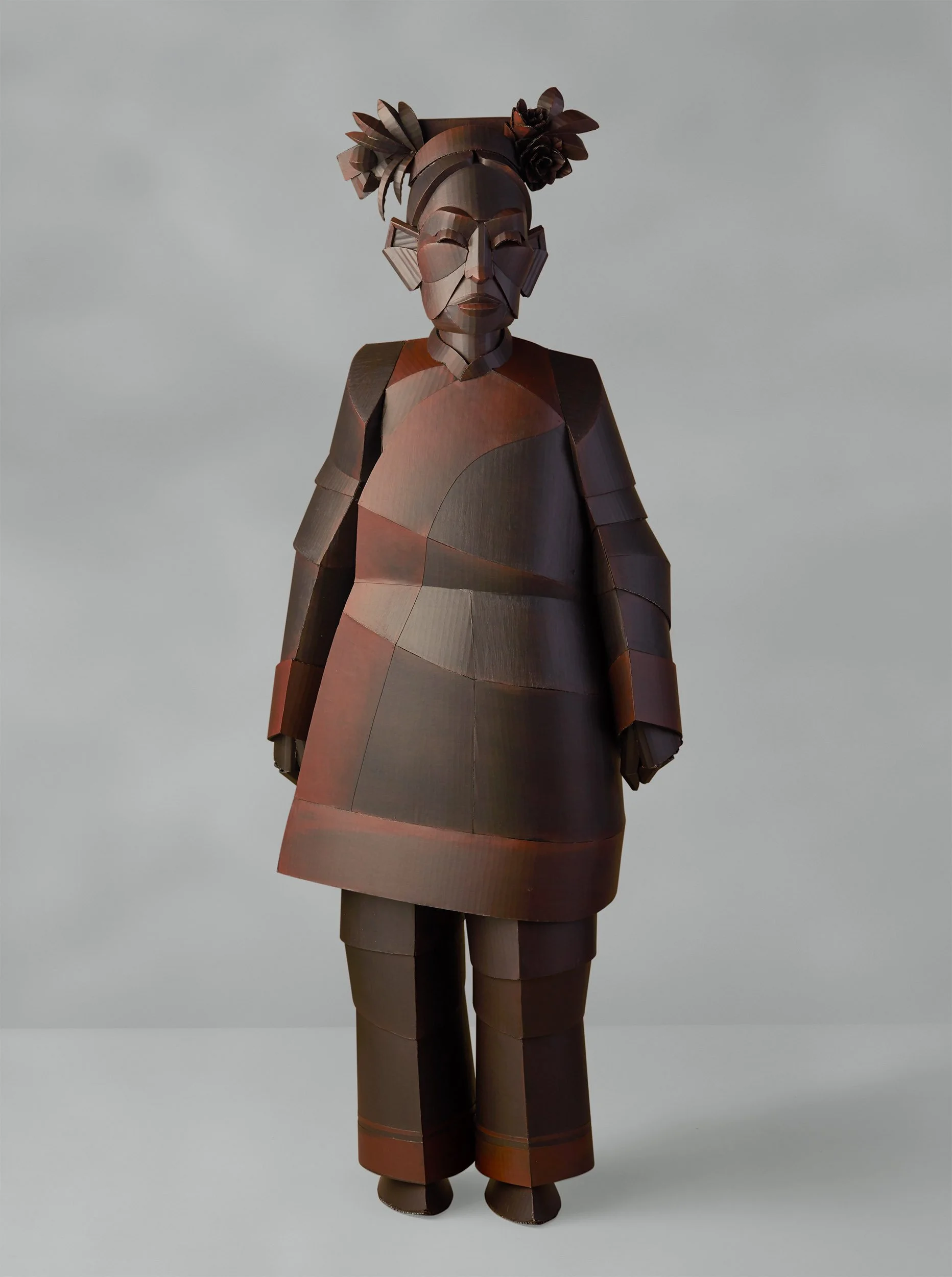
The Concubine’s Due, 2019
Corrugated cardboard, acrylic ink
47 x 17 x 13 in.
When my grandfather was dying in a hospital in Taiwan, I was introduced to a woman the family referred to as his mistress. I was shocked, defensive, judgmental — I questioned her presence, her motives, her right to be there at all. But over the following weeks, as I learned the true nature of their forty-year relationship, I began to realize how much my reaction had been shaped by my own Western upbringing, and how unfairly I had judged a situation I didn't understand. This piece is a meditation on that realization — on how culture shifts across generations, how people sometimes adapt to those changes, and how sometimes they become trapped by them.
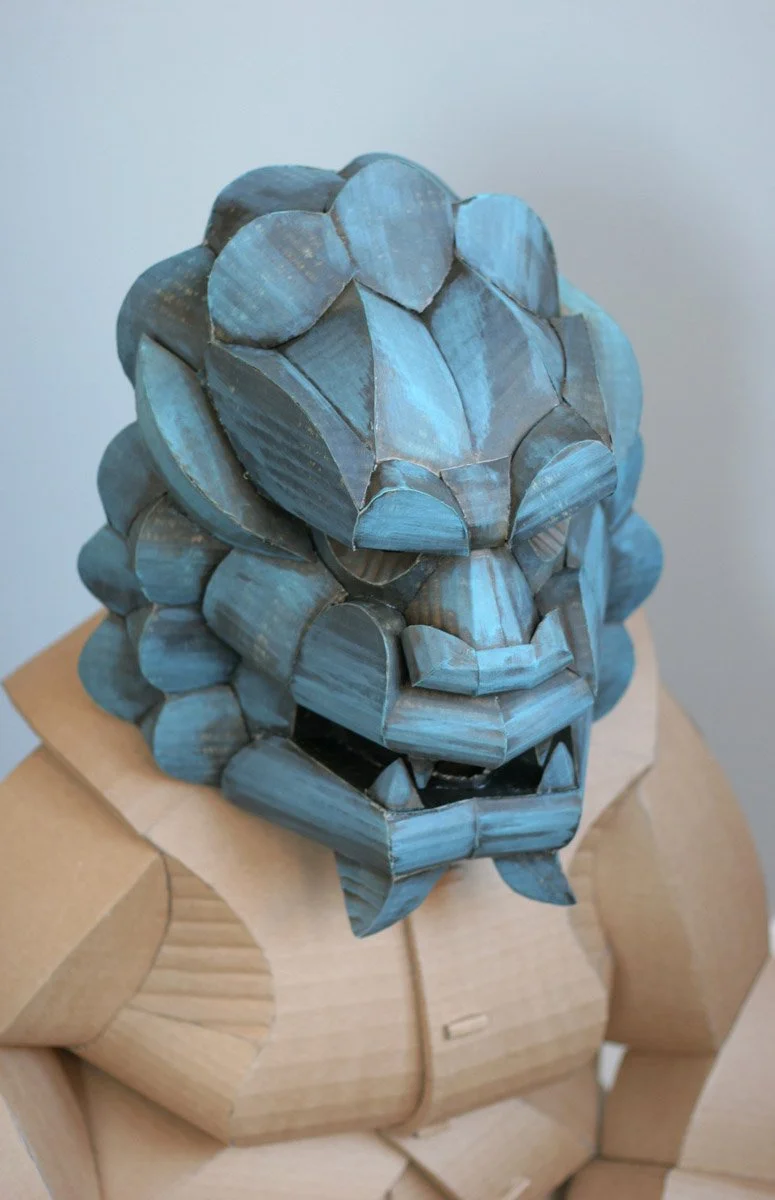
Grandmother, Masked, 2016
Corrugated cardboard, acrylic ink
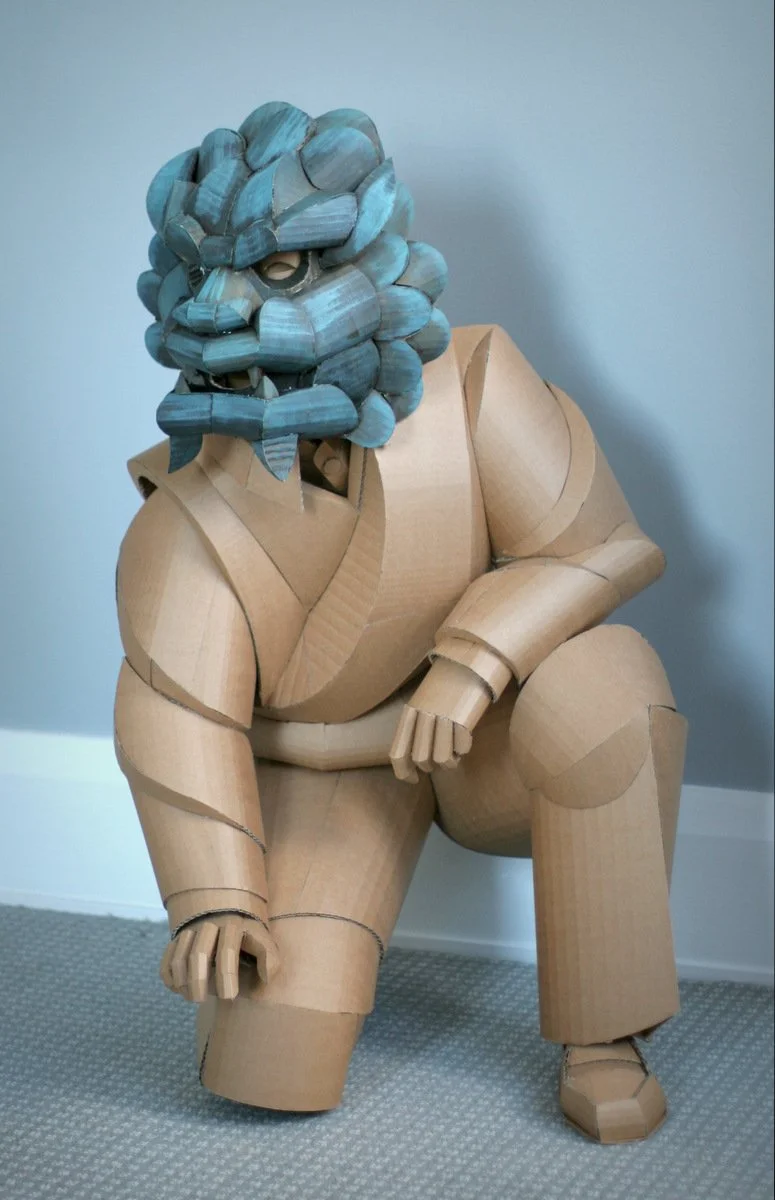
Grandfather, Masked, 2016
Corrugated cardboard, acrylic ink
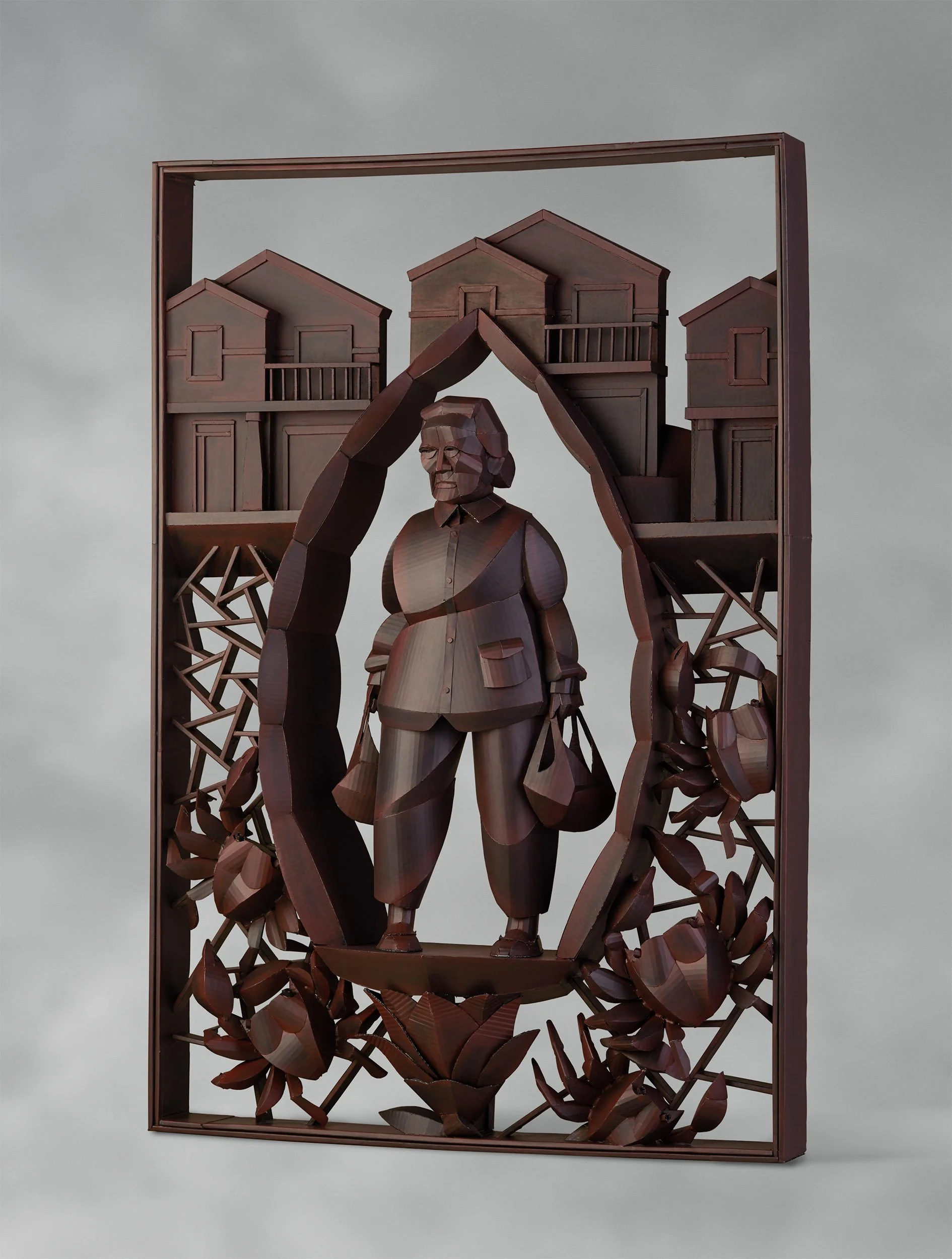
String for Shoes, 2018
Corrugated cardboard, acrylic ink
50 x 34 x 4 in.
My grandmother, Wai Po, lived with us for years in our suburban home outside Milwaukee, occupying the lower floor of our Tudor-style house, cooking and cleaning, knitting and sewing — a constant and quiet presence. She was so thoroughly a fixture of that place that I never thought to ask who she was before she became that. This sculpture places her as I knew her — a figure who looked as though she had been plucked from the Chinese countryside and deposited into a Midwestern suburb, with manicured lawns and peaceful cul de sacs. The juxtaposition was always there; I just never looked at it. It wasn't until I was an adult that I learned, in a single two-hour conversation, that the quiet woman in our kitchen had survived bombs, harrowing journeys, and losses I can barely fathom. This piece is about holding both of those images at once — the woman I thought I knew, and the one I never thought to ask about.
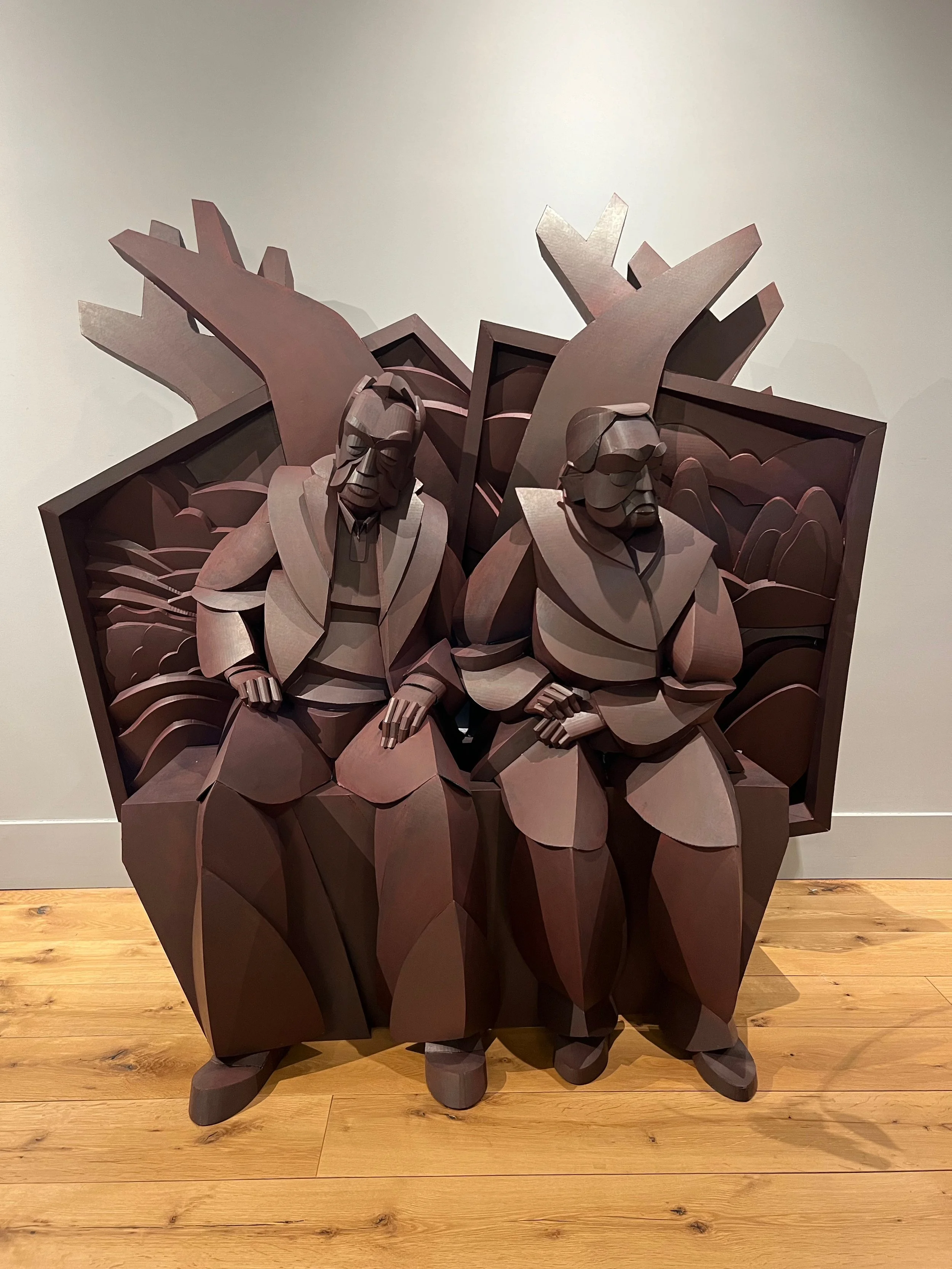
The Distance We’ve Travelled, 2024
Corrugated cardboard, acrylic ink
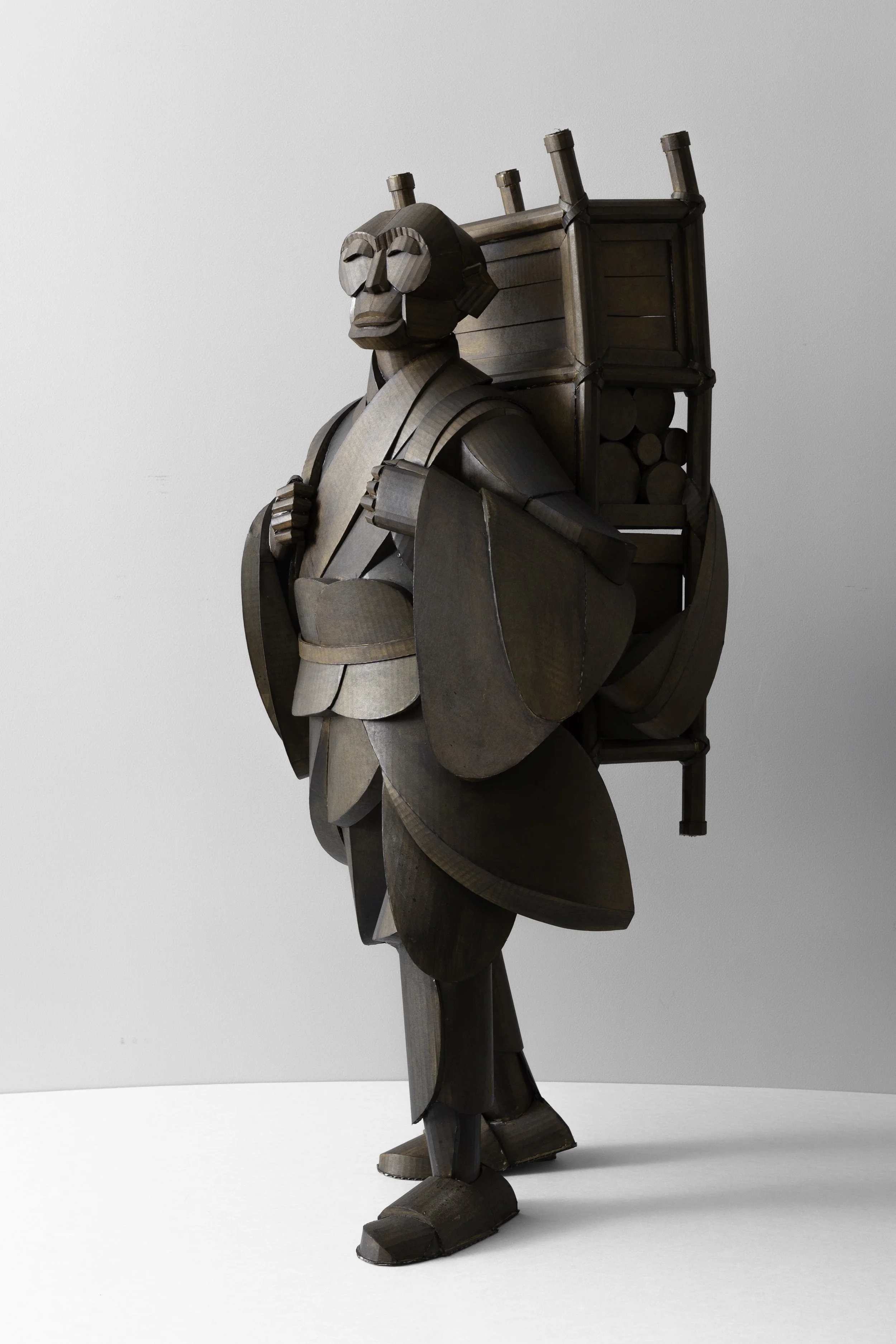
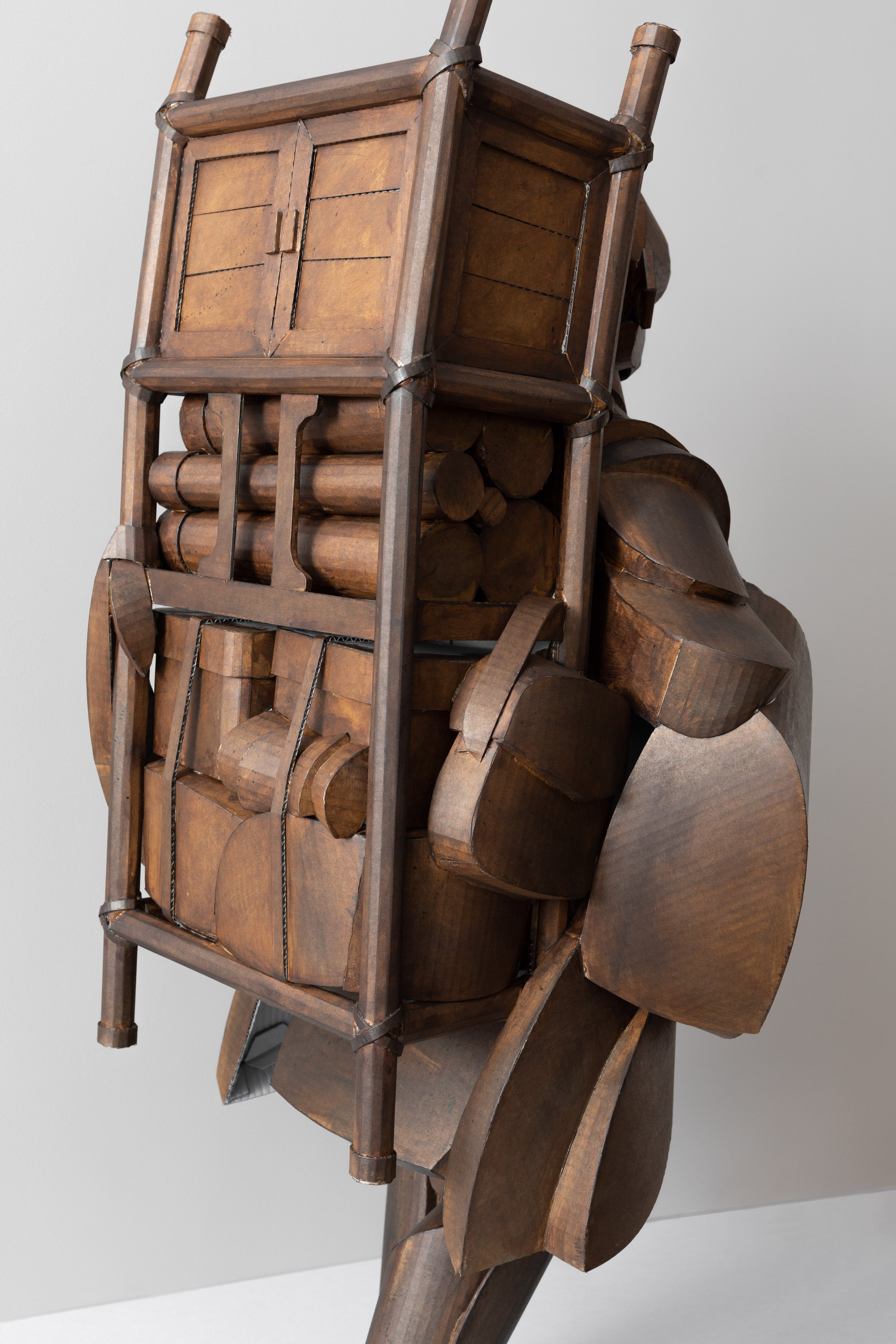
Xuanzang, 2022
Corrugated cardboard, acrylic ink
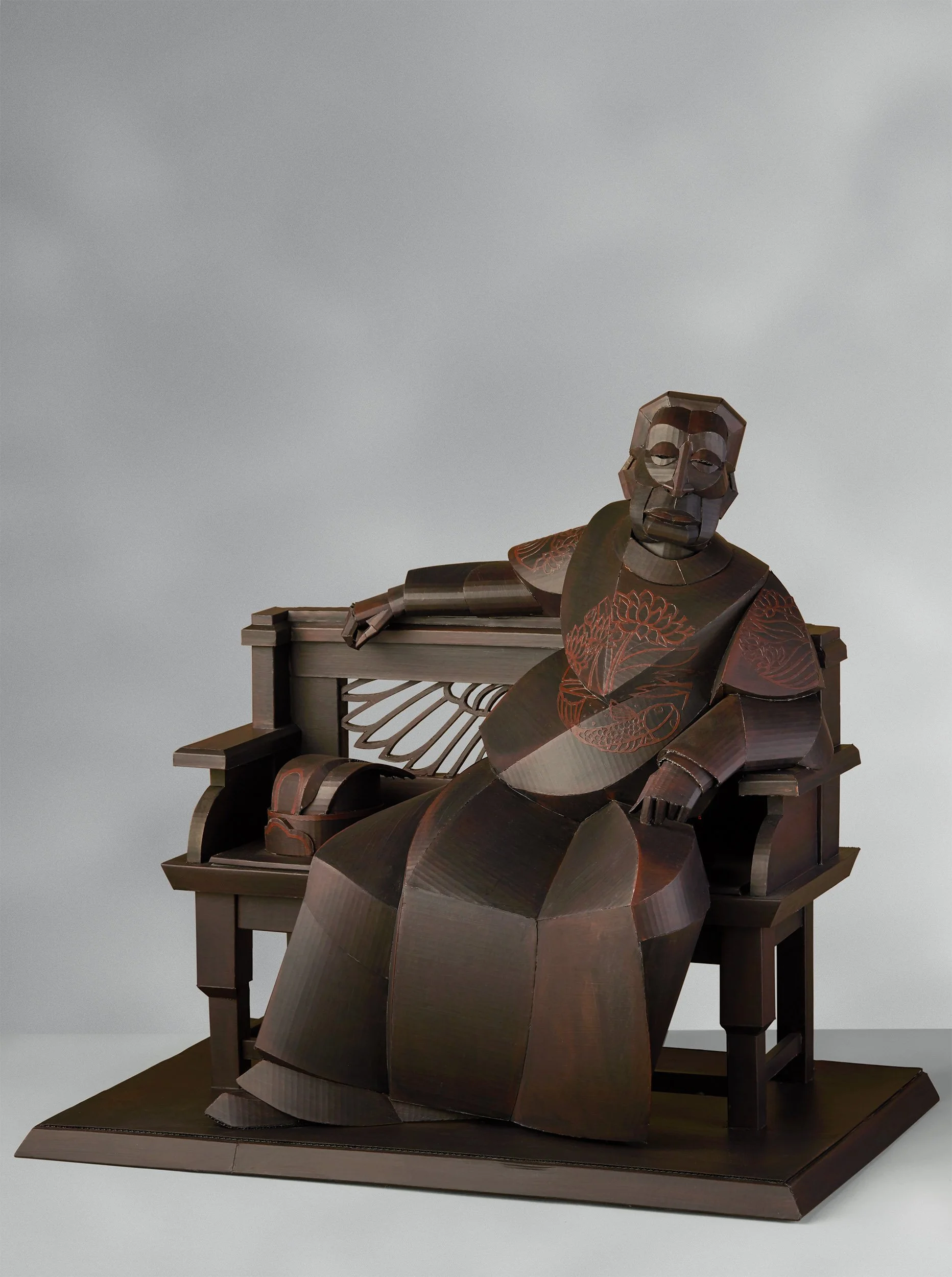
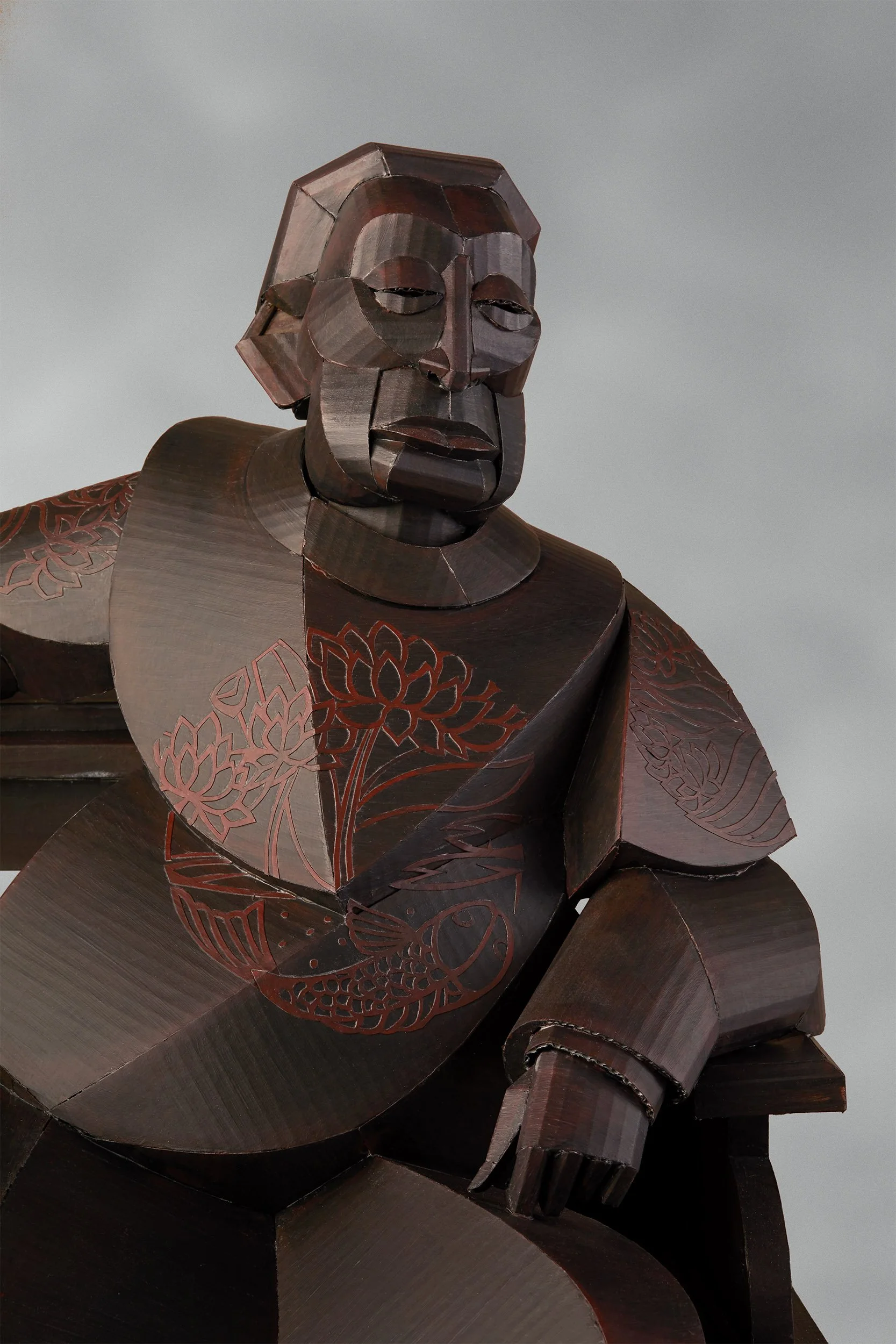
The Emperor Takes Five, 2022
Corrugated cardboard, acrylic ink
33 x 3 x 21 in.
Growing up in Wisconsin, I watched my friends with their grandfathers — casual, warm, easy — and wondered why mine was so different. My paternal grandfather carried himself like an emperor: reserved, aloof, perfectly groomed — and always at a certain remove from the grandchildren. It was the tradition he inherited, passed down from his own stern and distant father. This piece honors him in the way he would have wanted — modeled on the formal imperial portraits of Chinese emperors, figures shown without warmth or vulnerability, projecting only authority and composure. But I find that whenever I look back now, I can't help but wish something different for him. I wish I could have given him a moment's respite from the weight of all that expectation — a moment to relax, to joke, to speak freely. Perhaps it is a wish that only someone raised in the West could have for his Chinese grandfather
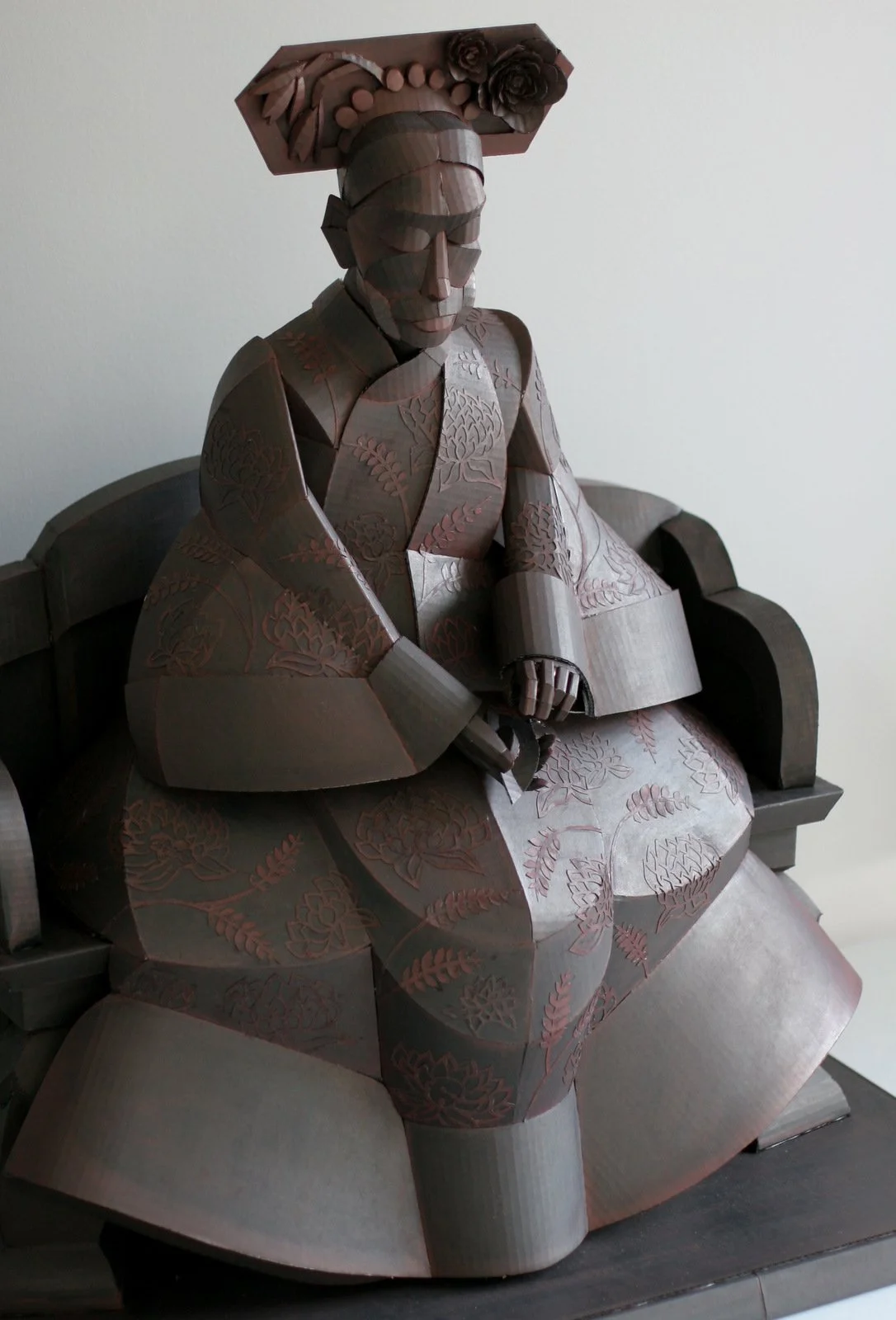
The Empress Keeps Her Secrets, 2018
Corrugated cardboard, acrylic ink
33 × 21 × 35 in.
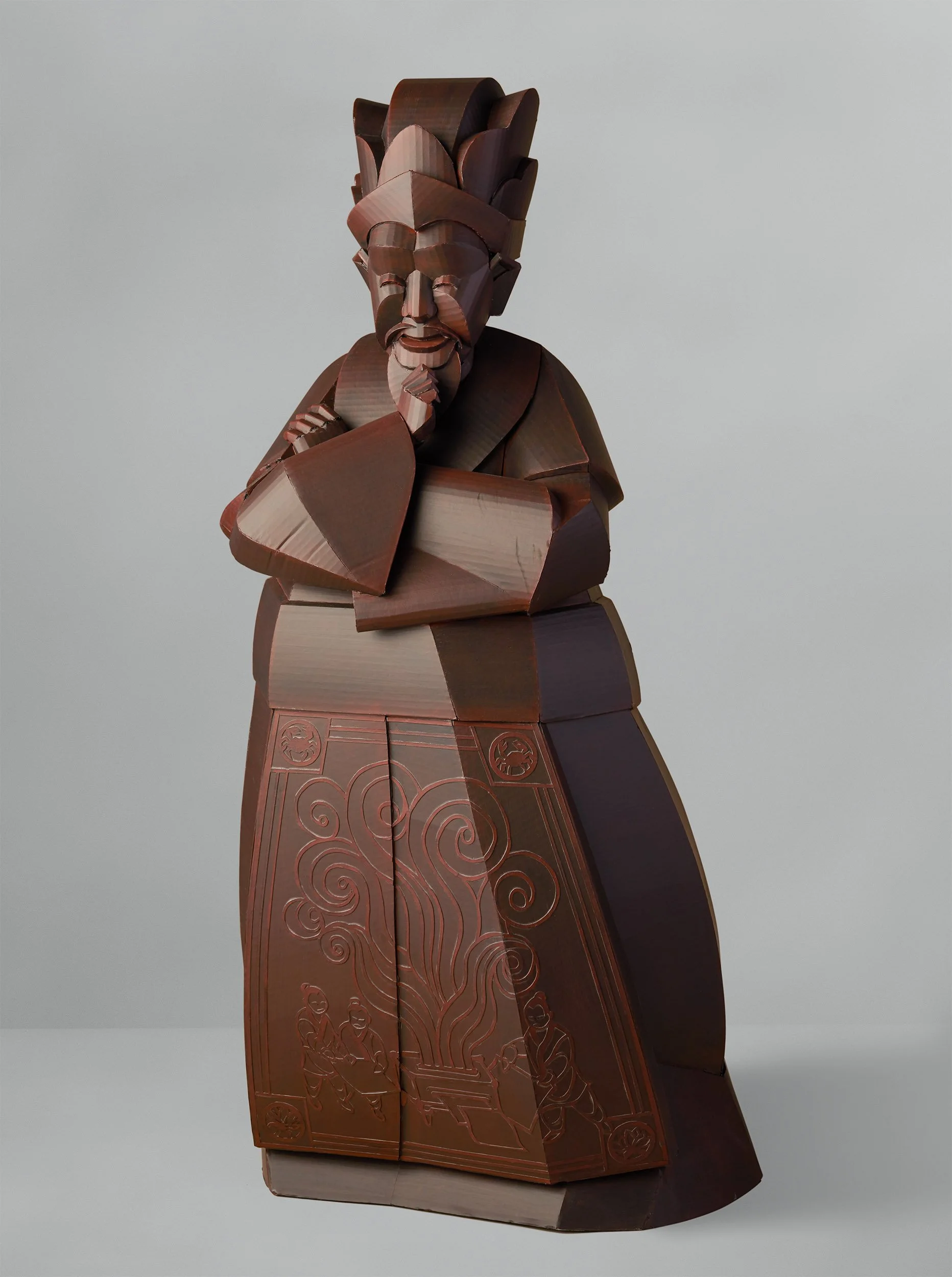
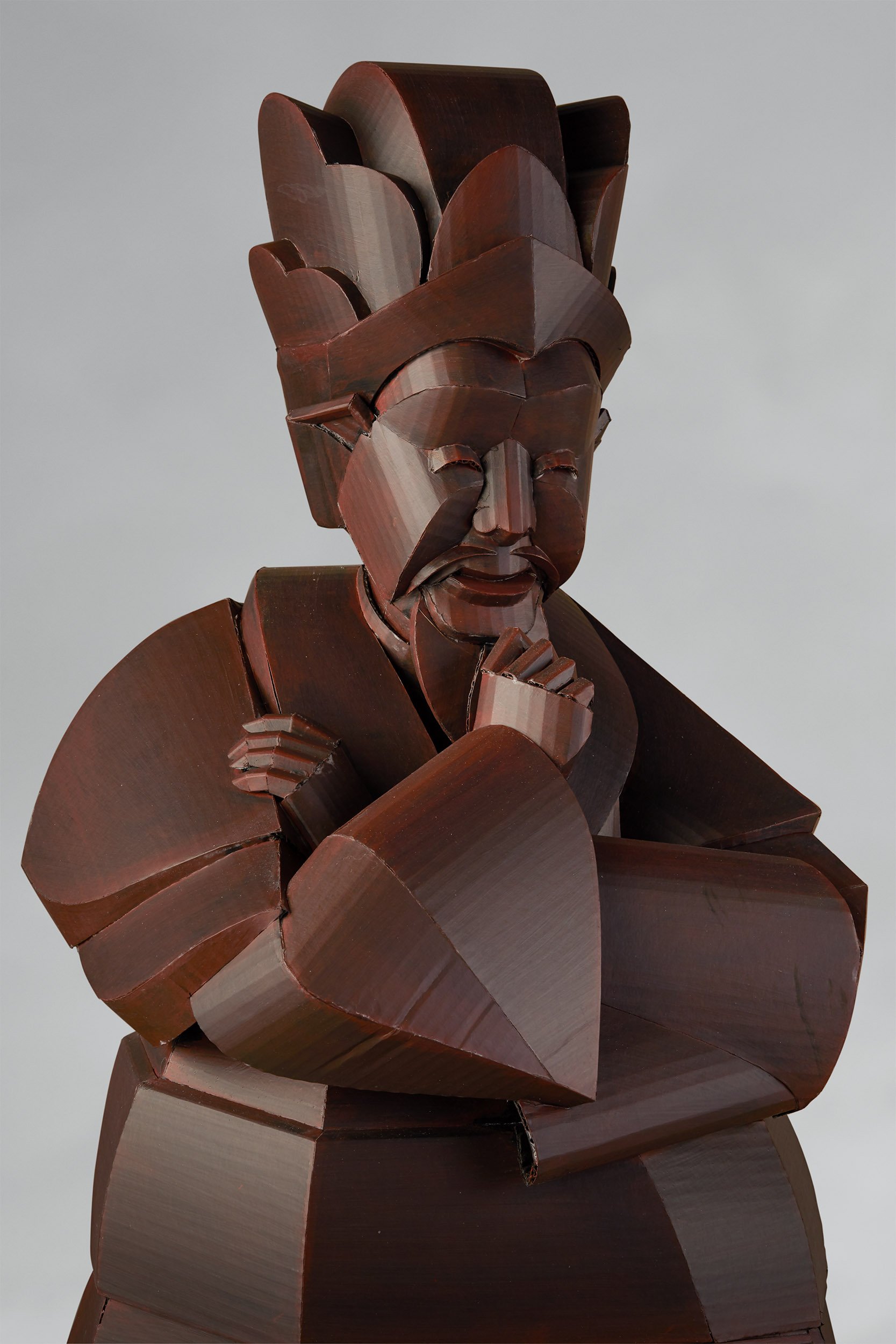
Prayers Carried on Drifts of Ammonia, 2018
Corrugated cardboard, acrylic ink
42 x 21 x 16 in.
My father was a structural engineer, but it was more than just an occupation. He built a business around it — a business that provided for our family like a hearth, but demanded all of our participation. As children, my brothers and I spent long weekends in the basement making blueprints, gathered around a machine that emitted blue light and ammonia fumes, toiling together in a way that none of my American friends could have understood or imagined. We dreaded those long hours, resented the lost weekends, and couldn't see the point. But now when I look back, I have a different perspective and a new appreciation. I remember a family — parents and three children — doing everything they could to secure their place in an adoptive country. A household working in unison, helping each other and the business grow. A family sharing the labors, sharing the fruits.
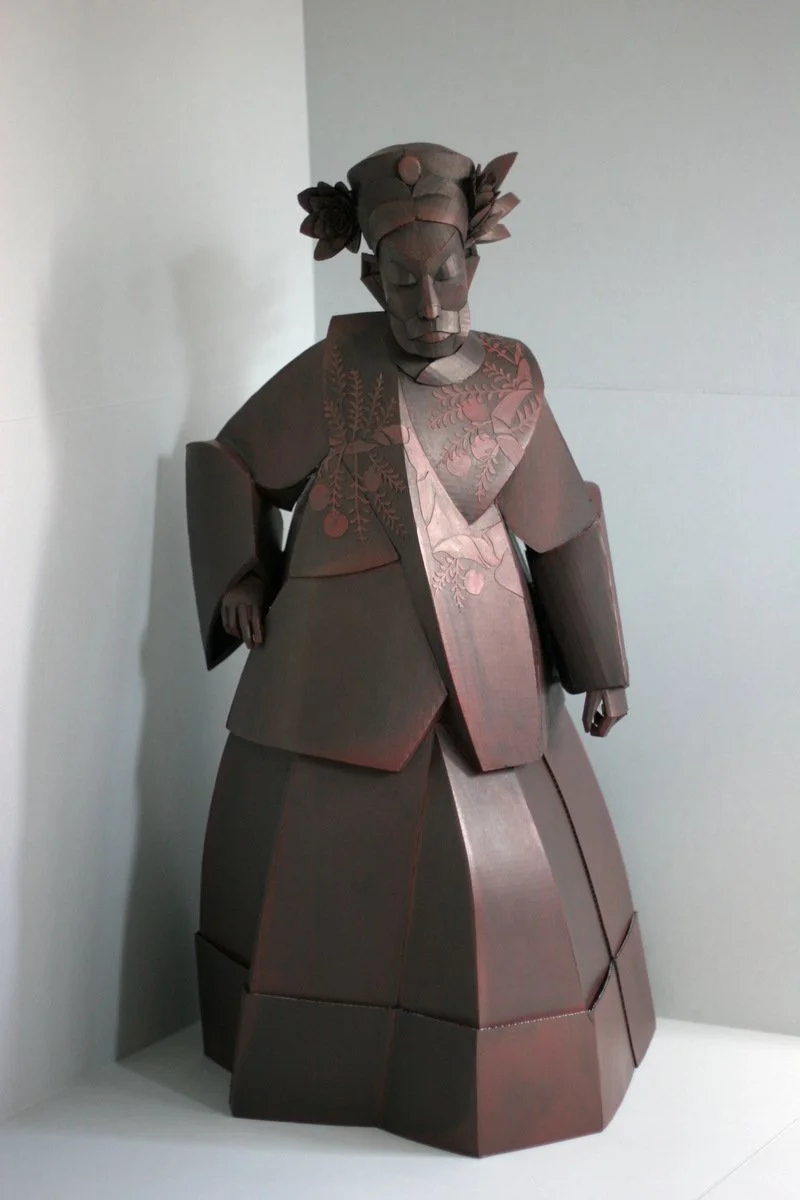
400 Apples a Day and Other Lies, 2018
Corrugated cardboard, acrylic ink
40 in. height
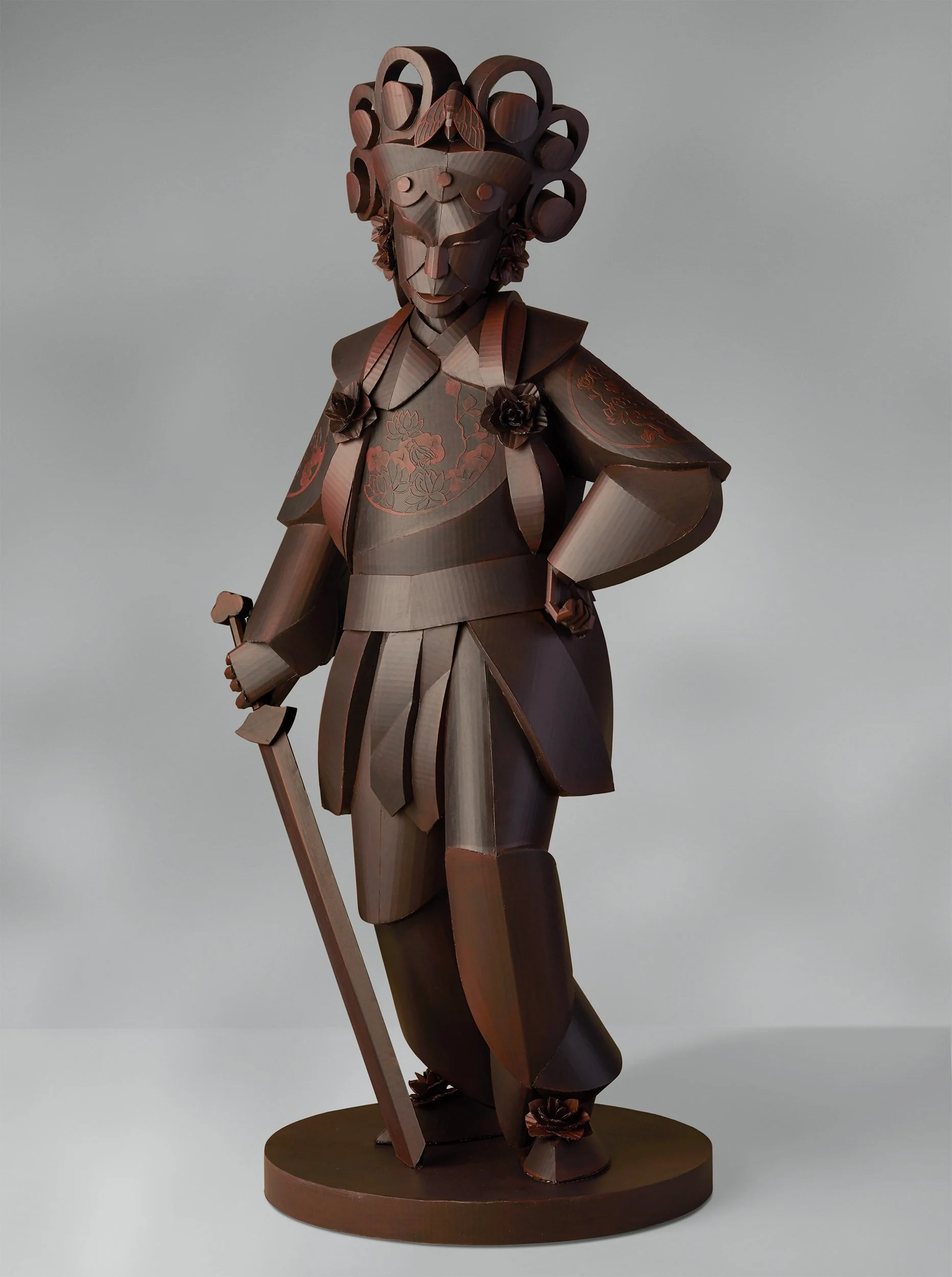
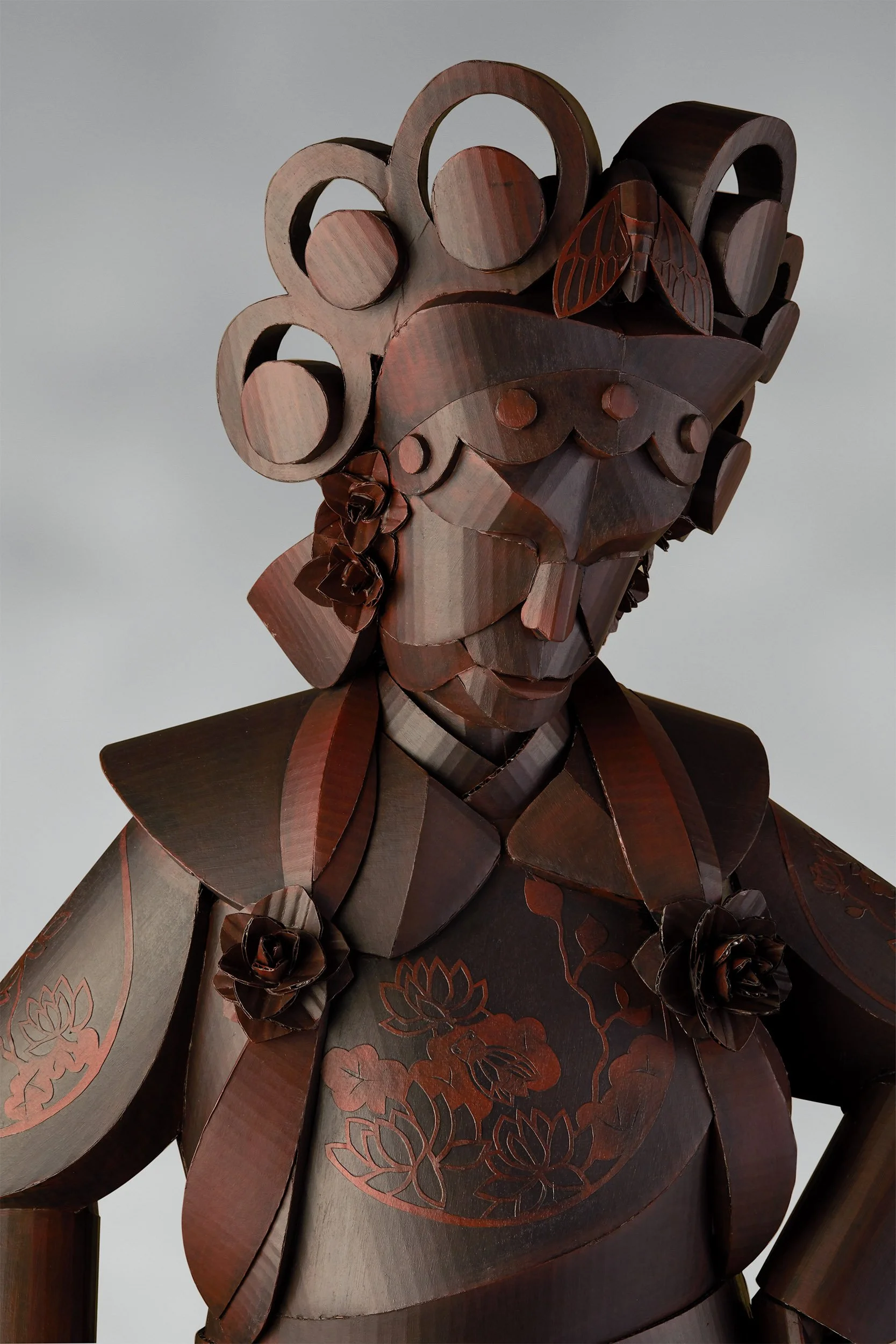
The Wu Dan Answers the Call, 2019
Corrugated cardboard, acrylic ink
47 x 17 x 13 in.
My grandmother was small, young, and had no military experience — but when the Chinese military announced it would begin accepting women, she walked straight to the recruiting office to enlist, ready to give up everything to fight. When I think about her in that moment — slight, determined, undaunted by an enemy that had already overwhelmed vastly larger forces — the story of David and Goliath came to mind immediately. For this piece, I borrowed the pose from Donatello's sculpture of David in his moment of triumph, but replaced David with the Wu Dan, the female warrior of Chinese opera. It is through both Western and Chinese lenses that I examine my grandmother's fearless spirit — the same spirit that would carry her through decades of war, displacement, and hardship, and eventually to the quiet suburbs of Wisconsin.